How long does SEO take? A real timeline, day by day
From 5 impressions a day to 26,000 a month in five weeks - and around twenty enquiries with zero ad budget. The full trajectory, measured in Search Console.

Contents
How long does SEO take? The honest answer is 3–12 months to stable results, depending on competition and your starting point - but the first measurable signals arrive much sooner than most people expect, provided the site is built right from the start. Instead of guessing, we'll show the whole trajectory with open numbers: stone company Stonepoint.se relaunched its website on 27 June and went from 5 impressions a day to 26,000 a month within five weeks - and from zero to around twenty enquiries a month. Without a krona spent on ads. Every figure below comes from Google Search Console and Google Analytics.
The SEO timeline phase by phase
| Phase | Timeframe | What happens |
|---|---|---|
| Indexing | Days - up to 2 weeks | Google finds and reads the pages. With clean tech and a submitted sitemap, it takes days. |
| Impressions | 1–5 weeks | Pages start appearing in search results, often at positions 20–50. Clicks are still rare. |
| Positions | 1–3 months | The average position climbs as Google gathers data on how the pages perform. |
| Clicks and customers | 2–6 months | Pages that reach the top 10 start generating clicks and enquiries in earnest. |
| Stable results | 6–12 months | Authority, links and content depth decide who owns the top 3 long term. |
What decides how fast you can appear on Google?
How fast you can appear on Google depends less on how much you write and more on five factors that set the pace. A company in a local niche can take the top 10 in a quarter; an agency in a hard service segment in Stockholm should count in years for the same placement.
- The competition level of your searches - the single biggest factor. A niche where the top five have 30 linking domains is a completely different task from one where they have 3,000.
- Domain history - an established domain with previous traffic starts far ahead of one registered last week. In a relaunch the history carries over, provided the redirects are done right.
- The technical condition of the site - indexing, speed and structure decide whether Google can read the pages at all, and therefore whether the clock starts on day one or in week six.
- Number of pages and content depth - a site with ten thorough pages per topic area gathers signals faster than one with a single thin service page.
- Links and local signals - the last metres into the top 3 are almost always about authority: mentions, reviews and links from sources Google already trusts.
| Starting point | First impressions | First clicks | Top 10 on commercial searches |
|---|---|---|---|
| Existing site, on-page optimisation | Immediately (already indexed) | 4–8 weeks | 2–6 months |
| Relaunch of an established domain | Days | 3–8 weeks | 3–9 months |
| New domain, low competition (local niche) | 1–2 weeks | 1–3 months | 4–8 months |
| New domain, hard competition (services in Stockholm) | 2–4 weeks | 3–6 months | 9–18 months |
The case below sits in row two: a relaunch on a domain that already existed. That explains why the impressions arrived within days - but also why the clicks are still lagging after five weeks.
Why does SEO take so long? The starting point decides
In the six weeks before the relaunch - 19 May to 26 June - the old website collected 216 impressions and 34 clicks in total. An average of 5–6 impressions a day. Nearly all clicks came from searches for the company name, where the site sat at position 1: people who already knew the business and googled it. On generic searches like "köksbänkskiva" (kitchen countertop) or "granit bänkskiva" (granite countertop) - the searches where new customers actually are - visibility was effectively zero. Enquiries from search engines: zero. On the commercial searches the picture was just as clear: the handful of non-brand queries that registered at all sat at positions 22–42 and produced zero clicks. Commercial visibility: none whatsoever.
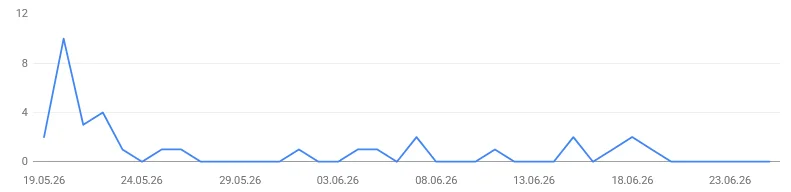
This situation is more common than you'd think. The site "is on Google" - anyone searching the company name finds it - so everything appears to work. But a website that only ranks for its own name is a digital business-card holder, not a sales channel.
What was built before launch
The timeline below is only possible because the groundwork was done before launch, not after. The new site was built with the search structure as its blueprint:
- A category structure mirroring how people search - separate pages for granite, marble and limestone countertops, window sills and bathrooms instead of a single "Our products" page.
- Guides per stone material that capture informational searches and link on to the product pages.
- A technical foundation following the checklist in our technical SEO guide: fast loading, clean indexing, structured data and a sitemap submitted on day one.
- Titles and page structure following the principles in SEO optimisation: 12 actions - every page answers its own search instead of competing with its neighbours.
The order is the point: structure and tech before launch, content depth and links after. Rebuilding a site that has already been indexed wrong is double work - Google first has to forget the old picture before the new one settles.
How fast does a new site get indexed? Days, not months
The relaunch happened on 27 June. The next day, Search Console registered 58 impressions. Two days later: 202. After three days: 468. Within a week the site sat steadily above 600 impressions a day - on searches it had never appeared for before. The myth that Google needs months to discover a new site doesn't hold when the tech is clean: indexing took days. What does take months is the next step - climbing from position 25 into the top 10.
How long does it take to reach the top 10? Positions climb from 23 to 18
The impression explosion is only half the story - in the first weeks the pages appeared far down the results, with an average position around 24. Then came a period where it looked like things were going backwards: the average worsened to 27.5 at its worst on 11 July while new pages took their place in the index. Only from week four did the curve turn in earnest - the weekly average went from 22.7 in the first week after launch to 17.6 in the last. Over the 29 days from 5 July to 2 August, Search Console registered 26,134 impressions and 136 clicks. The category pages pull the hardest: the granite countertop page alone accounted for 6,875 impressions at position 12.
| Search query (Swedish) | Impressions (29 days) | Position |
|---|---|---|
| köksbänkskiva - kitchen countertop | 296 | 10.1 |
| granitskiva - granite slab | 246 | 11.4 |
| granit bänk - granite counter | 141 | 10.1 |
| granitbänkskiva - granite countertop | 44 | 8.6 |
| fönsterbänk marmor måttbeställd - custom marble sill | 24 | 6.7 |
| röd marmor bänkskiva - red marble countertop | 13 | 4.2 |
| marmor - marble (generic) | 304 | 37.8 |
The pattern in the table deserves a pause: the more specific the search, the higher the position - "red marble countertop" sits at 4.2 while generic "marble" sits at 37.8. That's what a healthy start looks like. Specific searches with clear buying intent are won first; broad single-word searches require authority built over years - and are rarely the ones that bring customers.
From impressions to enquiries: around twenty contacts in a month
Search Console numbers are nice, but the question that matters is whether the phone rings. Five weeks after launch we put it straight to the client. The answer:
"Somewhere around 20 contacts. Some questions but mostly real leads. That's more or less from zero. So at least a 1000% increase."
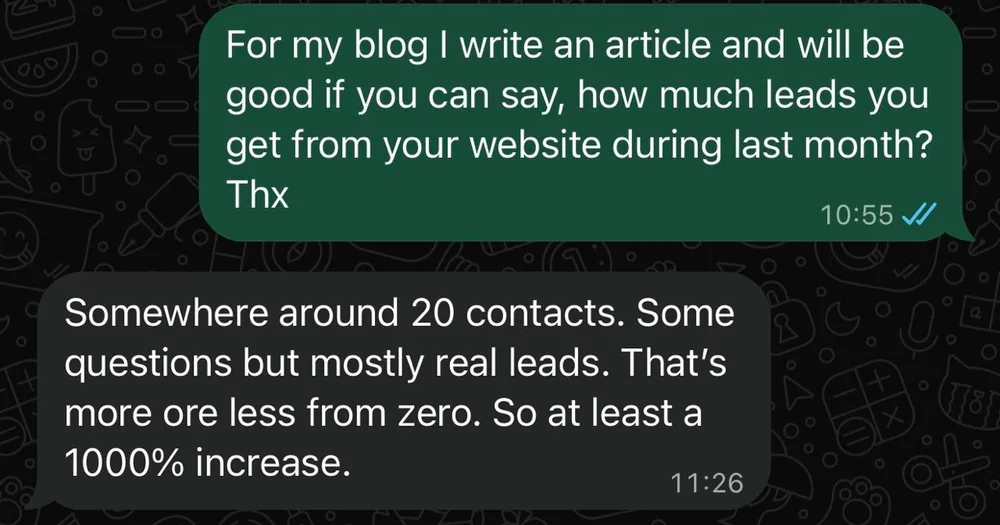
The twenty contacts are the client's own count across every route in - calls, forms and emails. Conversion tracking is the next step in the project, so every enquiry can be traced to its source. What we can document exactly right now: the ad budget for the period was 0 kr. Google Analytics shows 0 sessions from paid traffic - the channels are organic search, direct traffic and one newcomer we will get to shortly. What you see is what the website alone delivers, before any advertising or link building.
Visible in AI search before Google gave full credit
One detail in the Analytics data points forward: five sessions came from ChatGPT, which already cites the site's guides as a source for stone questions. Five sessions is not a traffic channel - but the fact that a five-week-old site gets picked up by AI search at all shows that the same groundwork that convinces Google convinces the language models too. Structured content that answers real questions is the currency in both systems - the same mechanics we build on in our AI services.
What hasn't happened yet: a 0.5% CTR
An honest status report needs the minus column too. 26,000 impressions produced 136 clicks - a click-through rate of 0.5%. That's expected for positions around 10–17: most Google clicks go to the top 3–5, and a page at position 12 is seen by many but clicked by few. The next phase of the project is therefore not about more impressions but about converting them: lifting pages from positions 12–15 into the top 5, sharpening titles and descriptions so they win the click, and building the links and review signals that separate the top 3 from the rest. With the same impression volume and a 3–4% CTR - normal for the top 5 - the same site would deliver 800–1,000 visits a month instead of 136. If you want to see what a timeline like this could look like for your own site, an SEO consultant in Stockholm can walk you through it.
How to read your own timeline in Search Console
If you want to run the same follow-up for your own website, four curves matter, in this order:
- Coverage/indexing - are the pages indexed at all? Before everything else. A new site with clean tech should be indexed within days, not months.
- Impressions - the first curve to move and your earliest quality signal. If impressions grow week over week, the direction is right even if clicks lag.
- Average position per query - track individual important searches rather than the site-wide average, which gets distorted every time you start appearing for new queries far down.
- Clicks and CTR - the last curve to come loose. Low CTR at positions 10–20 is normal; low CTR in the top 5 means the title isn't winning the click.
The interpretation rule is simple: don't worry about clicks lagging as long as impressions and positions move the right way - but if the impression curve is flat six weeks after launch, something structural is wrong, and the digging should happen in indexing and tech, not in writing more copy.
Where does your website sit on the timeline? Our free visibility analysis reviews your indexing, positions and click-through rate and shows which of the steps is your bottleneck - no strings attached.
Further reading
The full Stonepoint project - structure, technology choices and the material guides behind the numbers - is in the Stonepoint case study. The fundamentals of why search engines reward some sites and not others are explained in What is SEO?, and what you can fix yourself first is in SEO optimisation: 12 actions.
Common questions about SEO and time
How long does SEO take?
Expect 3–12 months to stable results: indexing in days, first impressions within 1–5 weeks, clicks and customers after 2–6 months. The pace is set above all by the competition level of your searches, the domain history and the technical condition of the site - a new domain in a hard segment sits at the upper end of the range, a relaunch of an established domain at the lower. The table and timeline above show how it looked in a real case.
Why isn't my new website showing on Google?
Check in this order: is the site indexed (search site:yourdomain.se), is there a submitted sitemap in Search Console, and is robots.txt or a stray noindex tag blocking by mistake? If all of that is green and the site is still invisible after 4–6 weeks, the problem is usually structural - the pages don't match any real searches, or every page competes for the same keyword. A new site with clean tech should start collecting impressions within days to a couple of weeks.
Can you speed up the indexing of a new site?
Yes, with three moves: submit a sitemap in Search Console on day one, request indexing manually for the most important pages via the URL inspection tool, and make sure the pages link to each other so Google finds the whole structure from the home page. In the case in this article, the site went from launch to over 600 impressions a day in under a week - indexing is rarely the bottleneck when the tech is clean.
What happens to SEO when you relaunch an existing website?
Done right, a relaunch is an accelerator: the domain's age and history carry over, and new pages are evaluated faster than on a completely fresh domain. The crux is the redirects - every old URL that disappears without a 301 redirect to its successor leaks authority and can lose positions that took years to build. Do a full URL inventory before launch, and expect 2–6 weeks of turbulence in positions while Google reads in the new structure.
Should you run ads while waiting for SEO results?
Often, yes - the two complement each other in time. Ads bring customers from day one while the organic build is under way, and the keyword data from the ad campaign also shows which searches actually convert - valuable steering for the SEO work. At the same time, the case in this article shows it can be done without: around twenty enquiries a month on organic visibility alone. What the ads route costs is worked through in What does Google Ads cost in Sweden?
How many clicks do 26,000 impressions give?
It depends almost entirely on the positions behind the impressions. In the case in this article: 136 clicks, i.e. 0.5% - normal when the average position sits around 10–17, since most clicks go to the top 3–5. The same impression volume with pages in the top 5 typically gives a 3–4% click-through rate, i.e. 800–1,000 visits. That's why impressions are an excellent early receipt but a poor end goal: the value appears when positions climb into the top.
Where does your website sit on the timeline?
We review your indexing, positions and click-through rate against your competitors - free of charge, concrete and with no strings attached.