What Is SEO? Search Engine Optimisation Explained
A grounded guide to how Google works - and what your business actually needs to do to be found in search results.
Contents
SEO stands for Search Engine Optimisation. It's the umbrella term for all the work that goes into getting a website to appear high in Google's organic (unpaid) search results. The difference from Google Ads is simple: Ads are rented visibility that disappears when the budget runs out; SEO is earned visibility that stays.
What does SEO actually mean?
The acronym SEO comes from Search Engine Optimisation. The term was coined in the mid-1990s when companies started realising that some pages ranked higher than others for the same query - and that this position could be influenced deliberately. Today Google dominates the Swedish search market with over 95% market share, so when people say "SEO" in Sweden they basically mean Google optimisation.
Three related terms keep coming up in the same context:
- SEM (Search Engine Marketing) - umbrella term covering both organic SEO and paid search advertising.
- SERP (Search Engine Results Page) - the results page itself, including snippets, maps and images.
- SERP features - enhanced results like FAQ boxes, featured snippets, local packs and People Also Ask.
How does SEO work in practice?
Google ranks websites using an algorithm that evaluates hundreds of signals. The basic flow looks like this:
- Crawling - Google's bots (Googlebot) follow links and discover pages on the web.
- Indexing - the content is analysed and stored in Google's index if the page is deemed worth showing.
- Ranking - when someone searches, the algorithm decides which indexed pages best match the search intent.
- Display - the top 10 results land on the first SERP page, where 75% of all clicks happen.
Only 0.63% of Google users click through to the second page of search results. Not ranking in the top 10 is, in practice, the same as not existing.
The three pillars of SEO
SEO work is usually divided into three categories that together determine how well a site ranks. Focusing on just one of them rarely delivers - all three need to work.
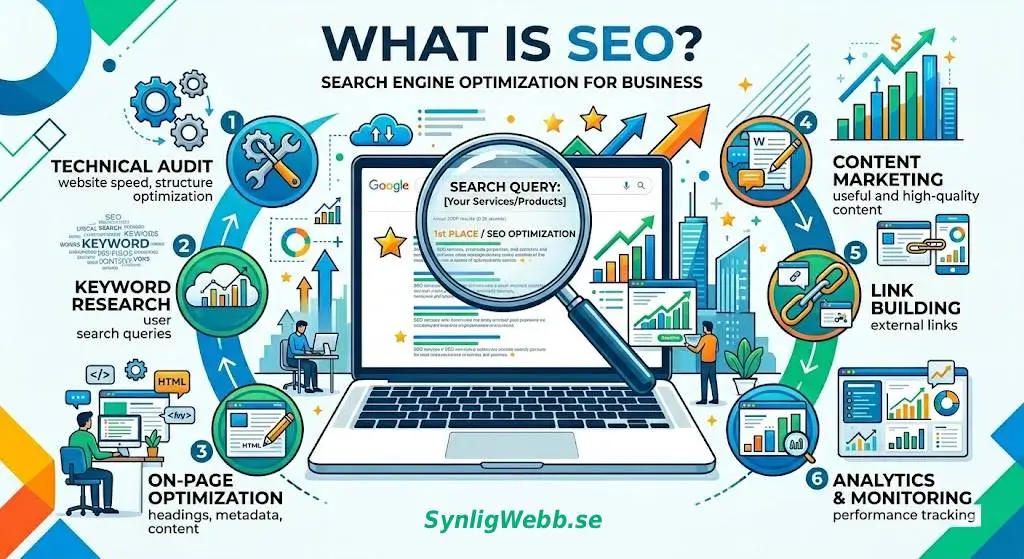
1. Technical SEO
Everything to do with how Google can read, understand and index your site. That includes load speed, mobile responsiveness, secure HTTPS, correct meta tags, structured data (schema.org), XML sitemap and robots.txt. A broken technical foundation makes the rest of the SEO work meaningless - Google can't rank what it can't read.
2. On-page SEO (content)
The work on the pages themselves: relevant content that matches search intent, proper heading structure (H1–H6), natural keyword usage, internal linking between related pages, optimised images with alt text, and meta descriptions that actually get people to click from the SERP.
3. Off-page SEO (authority)
Signals from other websites. Mainly this is backlinks - links from other sites to yours. Google treats each quality link as a vote of confidence. The number of links matters less than quality: one link from a major newspaper is worth hundreds of links from low-quality directories.
SEO vs SEM - what's the difference?
The single most common confusion we encounter with clients. Short version: SEM is the umbrella, SEO is half of it.
| SEO | SEM (Google Ads) | |
|---|---|---|
| Cost per click | 0 kr (organic) | 1–80 kr depending on niche |
| Time to results | 3–6 months | Same day |
| Effect over time | Long-term - keeps delivering traffic | Stops when the budget stops |
| Click-through rate (CTR) | Higher - users trust organic results more | Lower - ads marked "Sponsored" |
| Suitable for | Long-term growth, brand building | Launches, seasonal campaigns, quick tests |
In practice, most serious companies combine both. Our SEO agency works long-term on organic visibility while ads run by a Google Ads consultant in Stockholm deliver immediate traffic while SEO builds up.
How do you know SEO is working?
SEO isn't mysticism. It can be measured - if you know what to look at. The four KPIs we report on every month:
- Google positions - number of keywords ranking in top 3, top 10, top 30. Measured via Ahrefs, Semrush or Search Console.
- Organic traffic - number of visits from search engines per month, tracked in GA4. The most important number - more visits means more business opportunity.
- Click-through rate (CTR) - how many people actually click on your page when it shows in SERP. Indicates whether title and meta description are working.
- Conversions from organic traffic - contact forms, calls, purchases. This is the only number that actually matters for the business.
Common misconceptions about SEO
- "SEO is a one-off task" - Google updates its algorithm several times a year. Competitors publish new content. SEO is ongoing maintenance, not a project phase.
- "More keywords = better ranking" - Keyword stuffing has been penalised by Google since 2011. A keyword should appear naturally in the text, not twenty times in the same paragraph.
- "SEO is dead thanks to AI" - Traffic to organic Google results has not declined in Sweden. AI Overviews affect some niches, but for local and commercial searches classic results still dominate.
- "We don't need SEO, we have Google Ads" - Ads stop delivering the day the budget stops. Sites without SEO are permanently dependent on paid traffic.
- "Fast SEO exists" - No serious agency guarantees position #1 within 30 days. Anyone who promises it usually builds spam links that lead to a Google penalty.
Does my business need SEO?
Practically every company with a website benefits from SEO, but relevance varies:
- High relevance - local services (workshop, dentist, hairdresser), e-commerce, B2B services where the buying journey starts with a Google search.
- Medium relevance - established brands with strong word-of-mouth, where search engines are mainly used for the brand name.
- Lower relevance - companies that sell exclusively through partners, trade shows or cold calls, or where the buying decision doesn't involve a web search.
If your customers start their buying journey with a Google search - and most do - SEO isn't optional, it's basic infrastructure.
Further reading
If you're wondering what SEO work actually costs in Sweden, read What does SEO cost? - it has price levels per setup, four pricing models and a worked example. What a new site costs is covered instead in How much does a website cost 2026?. For those looking to scale sales through partners rather than Google alone, Affiliate Marketing for Swedish Companies is a natural next step after SEO. For the technical side - Core Web Vitals, indexing and sitemaps - see our technical SEO guide. And to go from theory to action, SEO optimization: 12 actions lists exactly what to do and in what order.
Frequently asked questions about SEO
What does SEO stand for?
SEO stands for Search Engine Optimisation. It's the umbrella term for all the work done to get a website to rank higher in Google's organic search results.
What's the difference between SEO and search engine optimisation?
They're the same thing. SEO is the English acronym, search engine optimisation is the full term. Both are used interchangeably in the industry - professionals usually say "SEO", official documents tend to write "search engine optimisation".
Why does SEO take time to show effect?
Short answer: 3–6 months to measurable improvements, with the first movements in Search Console after 4–6 weeks. What sets the pace - and what a real trajectory looks like week by week - is covered in How long does SEO take?
Is SEO worth the money?
For companies where customers start the buying journey with a Google search, yes. Organic traffic has higher conversion rates than ads, costs nothing per click, and keeps delivering value for years. That said, ROI is measured over 12–24 months, not the first quarter.
Can I do SEO myself?
Yes, the basics can be learnt independently: proper heading structure, fast site, natural keyword usage. What gets hard without experience is technical SEO (Core Web Vitals, schema.org), in-depth keyword research and link building - that's where hiring an SEO consultant or agency usually pays off.
What does an SEO specialist do?
An SEO specialist works on three things: the technology (making sure the site can be indexed and loads fast), the content (pages that answer what people actually search for) and the authority (links and mentions). A normal week is a mix of analysis in Search Console, keyword work, copy, technical fixes and measuring what actually moved. The titles SEO specialist, SEO expert and SEO consultant mean roughly the same thing in Sweden - who does the work with us is on the page about our SEO agency in Stockholm.
Want help with SEO for your business?
We're an SEO agency in Stockholm working with small businesses and local services. Book a free review and we'll go through your site and show you concrete actions.